
Search for rare flowers and you will mostly find lists of botanical curiosities that nobody can buy — ghost orchids, corpse flowers, things that exist in two valleys and a conservatory. Useless if you want something unusual on a table this week.
- What actually counts as “rare” in the UAE flower market
- Protea, anthurium, bird of paradise & cymbidium orchid
- Seasonal rarities: peonies, ranunculus & when they bloom
- Why rare flowers cost more
- Caring for rare & exotic blooms once they arrive
- Lead times for special & custom orders
- FAQ: rare & unusual flowers in the UAE
- Ordering something unusual
This is the other list. Every flower here is genuinely obtainable in the UAE, and most of them last considerably longer than the roses they cost more than. We deliver fresh flowers across the UAE, so we see which of these people actually ask for — and what is involved in getting them here.
What actually counts as “rare” in the UAE flower market
Rare in the UAE does not mean botanically rare. It means rare in supply.
Almost nothing is grown here at commercial scale — the climate rules it out. Every cut flower in the country arrives by air, and what is easy to buy is whatever moves in high volume on established routes: roses out of Ecuador, Kenya and the Netherlands, carnations, chrysanthemums, lilies. Those are abundant because the freight is routine, not because they are common plants.
A flower becomes rare here when the volume drops. Protea is not an unusual plant in South Africa, where it is the national flower and grows on hillsides. It is unusual in a Dubai flower shop because comparatively few stems fly this way each week. Same flower, different scarcity. That distinction is worth holding onto, because it tells you what to expect. Rare-in-supply flowers are not fragile hothouse specimens that will collapse by Thursday. Several of them are the toughest, longest-lasting cut flowers in the trade. What they are is harder to get hold of at short notice — which is a scheduling problem, not a quality one.
Protea, anthurium, bird of paradise & cymbidium orchid
Four flowers that are routinely available in the UAE through the import trade, and almost never sitting in a shop when you walk in.
Protea
The most striking of the four, and the one least likely to be mistaken for anything else. A king protea head is the size of a grapefruit — a dense cone of spiky bracts around a woolly centre, in dusty pink, cream or deep red. It reads as architectural rather than pretty.
Vase life runs 10 to 20 days, and protea also dries well, so an arrangement can be kept as a dried piece afterwards rather than thrown out. Grown in South Africa, Kenya and Australia. Best for: a statement arrangement, a corporate reception, anyone who finds roses predictable. Not for: a traditional romantic gesture — protea is bold, not tender.
Anthurium
The glossy heart-shaped flower that looks lacquered. The coloured part is a spathe rather than petals, which is why it looks and feels waxy, and it comes in red, white, pink, coral and a deep burgundy that is nearly black.
Vase life of up to 28 days — four weeks from one stem. It is the single best value-per-day cut flower in this list. Grown mainly in the Netherlands and Mauritius. Best for: modern, minimal arrangements where a few stems do the work; offices, where longevity matters more than fragrance. Note that anthurium is also a very common houseplant, so be clear whether you want cut stems or a plant.
Bird of paradise
Strelitzia — the orange and blue crane-head flower that is instantly recognisable and looks like nothing else in a vase. Strongly tropical, strongly architectural, and tall, so it needs height and space rather than a compact arrangement.
Robust and long-lasting in the way tropical flowers generally are. Like anthurium, it is widely sold as a plant here, so specify cut stems if that is what you want. Best for: dramatic height, hotel and lobby work, anywhere the arrangement has to be seen across a room.
Cymbidium orchid
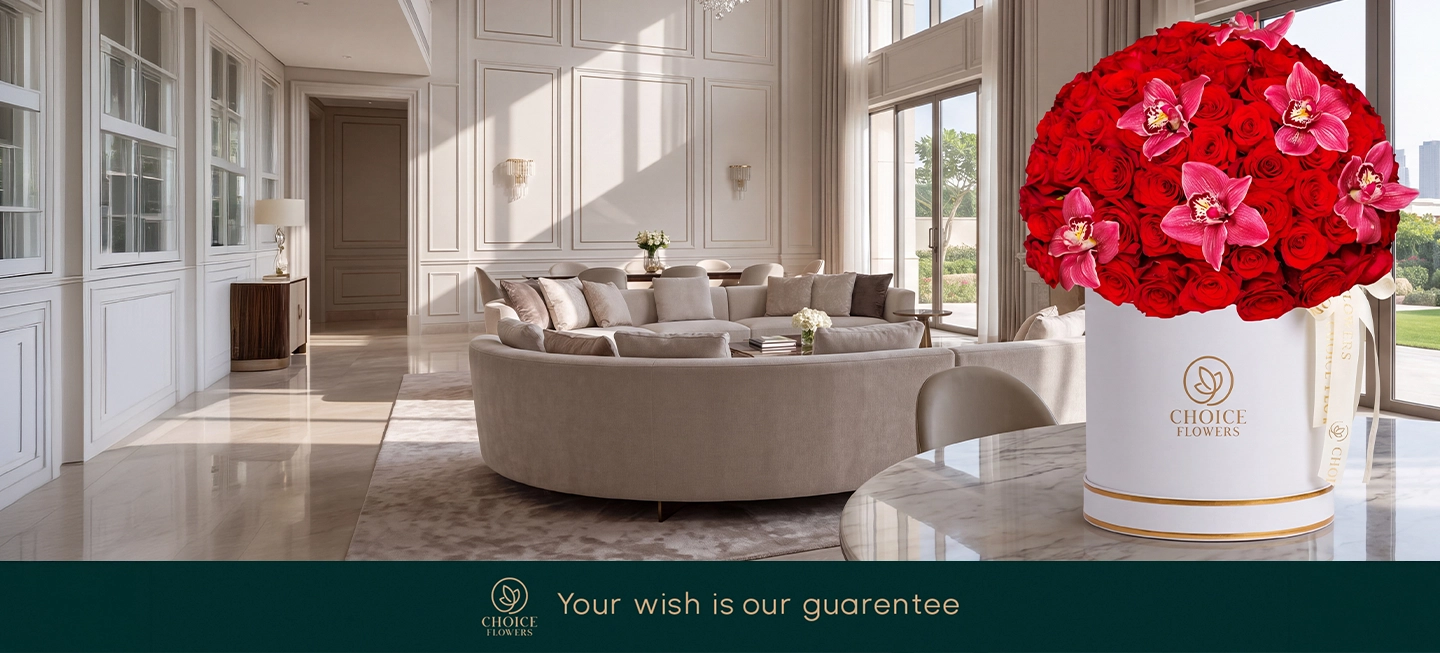
A spray orchid carrying several large waxy blooms on one arching stem, in green, cream, pink, burgundy and white, usually with a contrasting marked lip. More substantial than the phalaenopsis most people picture when they hear orchid.
Vase life of three to six weeks, provided it is kept away from ethylene — which is the one real catch, and covered below. That makes it the longest-lasting flower in this list by a clear margin. Grown in the Netherlands and Kenya. Best for: a gift that is meant to last, sympathy arrangements, and anyone who wants something quietly expensive-looking rather than loud.
None of these four sit in stock. They are ordered in for you — see lead times below. If you want something at the top of the range that is available now, our Luxury Flowers collection runs from AED 1,400 and is built around premium imported roses and seasonal peonies.
Seasonal rarities: peonies, ranunculus & when they bloom
Some flowers are not rare year-round — they are simply absent for most of it.
Peonies run March to June in the UAE, arriving from Holland growers during the European season. Outside that window they are effectively unavailable at any price, which is why peony enquiries in October have to be redirected rather than fulfilled. Ranunculus is a winter-into-spring flower, with its layered, tissue-paper heads arriving in the cooler months and gone by the time the heat sets in.
If peonies are what you are after, our guide to peony flowers in Dubai covers varieties, the season and what to expect on price.
Why rare flowers cost more
Four honest reasons, and one myth worth dismissing.
- Freight without economies of scale. Roses cross continents by the pallet, and the per-stem freight cost is tiny. Protea and cymbidium travel in small quantities on the same expensive aircraft, so each stem carries far more of the cost.
- Grower minimum orders. Specialist growers sell in set quantities. Sourcing enough protea for one arrangement often means buying more than one arrangement’s worth, and the price reflects that.
- Genuinely specialist handling. This is more complicated than keeping things cold — some of these flowers must not be kept cold at all. See the next section.
- Wastage risk. A florist holding specialist stock that may not sell prices in the stems that will not.
The myth: that rare flowers cost more because they do not last. The opposite is true for the ones on this page. A cymbidium orchid runs three to six weeks and anthurium up to four, against roughly five to seven days for roses and four to seven for peonies. Measured per day on the table, the expensive flowers are frequently the cheaper ones.
Caring for rare & exotic blooms once they arrive
Here is where most advice goes wrong, including advice written specifically for this climate. The standard UAE line is to keep flowers cool and away from the heat. For two of the flowers on this page, that is the opposite of what they need.
| Flower | Keep it | Why |
| Protea | Cool. Comfortable with the coldest spot in the room. | Handled at around 4°C in the trade. High temperatures are its enemy. Keep it in good light too — protea foliage blackens in the dark. |
| Anthurium | WARM — ordinary room temperature, never cold. | Handled at 13–18°C. Below about 13°C the spathe browns or greys. This is chilling injury, not drying out, and it does not reverse. |
| Cymbidium orchid | Warm, and away from fruit. | Handled at 13–18°C. Highly ethylene sensitive — ethylene causes translucent patches, darkening and flower drop. |
| Bird of paradise | Warm. Treat as tropical. | Robust, but a tropical flower with tropical preferences. |
The air-conditioning problem, properly explained
Everyone in the UAE knows not to put flowers under an AC vent, and most people think the reason is that the cold air dries them out. For roses that is roughly right. For anthurium and cymbidium the reason is different and the damage is worse: sustained cold air causes actual chilling injury to the tissue. An anthurium spathe that has been sitting in the draught from a vent will grey and brown in patches, and no amount of fresh water afterwards will bring it back.
So place these arrangements in a room at normal temperature, out of the direct airflow. Not in the coldest corner. Not in the fridge, ever — a habit some people have with roses that will destroy an anthurium overnight.
Water: use bottled or filtered
Post-harvest guidance for protea, anthurium and cymbidium all specifies avoiding softened water. Softened and desalinated supply is common across the UAE, which makes this more relevant here than it would be elsewhere. For an arrangement you are expecting to keep for three or four weeks, bottled or filtered water is worth the small cost. Change it every two to three days, and use the flower food sachet if one came with it.
The fruit bowl rule
Ripening fruit gives off ethylene, and cymbidium is highly sensitive to it. An orchid arrangement on the kitchen counter next to a bowl of bananas will drop blooms and develop translucent patches weeks before it should. Move it to another room. It is the single easiest way to add a fortnight to an expensive arrangement’s life.
Everything else is ordinary good practice: recut stems at an angle every few days, keep them out of direct sun, and remove anything that has gone over so it does not affect the rest. You can browse our full flower range for what is available without a special order.
Lead times for special & custom orders
| Order | Lead time | Notes |
| Protea | WhatsApp +971 55 166 7229 to check availability and lead time. | Depends on the next inbound consignment. |
| Anthurium | WhatsApp +971 55 166 7229 to check availability and lead time. | Warm chain, so handled separately from the cold-stored stock. |
| Bird of paradise | WhatsApp +971 55 166 7229 to check availability and lead time. | — |
| Cymbidium orchid | WhatsApp +971 55 166 7229 to check availability and lead time. | — |
| Peonies (in season, Mar–Jun) | WhatsApp +971 55 166 7229 to check availability and lead time. | Out of season, not available at any notice. |
| Large or event-scale quantities | WhatsApp +971 55 166 7229 to check availability and lead time. | Volume plus sourcing — expect longer. |
To order any of these, send us the flower, the quantity and the date you need it, and we will confirm availability and price before you commit to anything.
We deliver across Dubai and across Abu Dhabi.
FAQ: rare & unusual flowers in the UAE
Ordering something unusual
The short version: rare here means rare in supply, not rare in nature. Protea, anthurium, bird of paradise and cymbidium orchid are all obtainable in the UAE, all need ordering in advance, and all last substantially longer than the roses they cost more than. Keep the protea cool, keep the anthurium and the orchid warm, use bottled water, and keep the orchid away from the fruit bowl.
Tell us what you want and the date you need it, and we will confirm what is possible before you pay.
.webp)
